

What is the average size of nostrils? Methods to reduce size and ideal nose conditions

Many people worry, “My nostrils might be larger than average…” or “Is there a way to make them smaller?”
This time, we’ll explain the average size of nostrils and the ideal facial balance.
We’ve compiled information on how to check your own balance, reasons why your nostrils may appear large, and other common questions.
We also introduce cosmetic medical options that can address the size of your nostrils, so if you wish to achieve your ideal balance, please read on.
What’s the average size of Japanese people’s nostrils? Let’s check other features too.
This article explains the average size of Japanese people’s nostrils and the importance of balance.
Average diameter of the nostrils
There are no medically based average values calculated for the size of Japanese people’s nostrils, such as their diameter or surface area.
Generally, the average width of the nostrils is approximately 3.6 to 3.7 cm, and the average height is about 2.8 cm for women and about 3.0 cm for men, serving as a reference for the size and height of Japanese noses.
※The shape of the nose and its balance with other facial features also affect the overall impression of the face.
The balance of the “ideal nose tip” that determines one’s visual impression
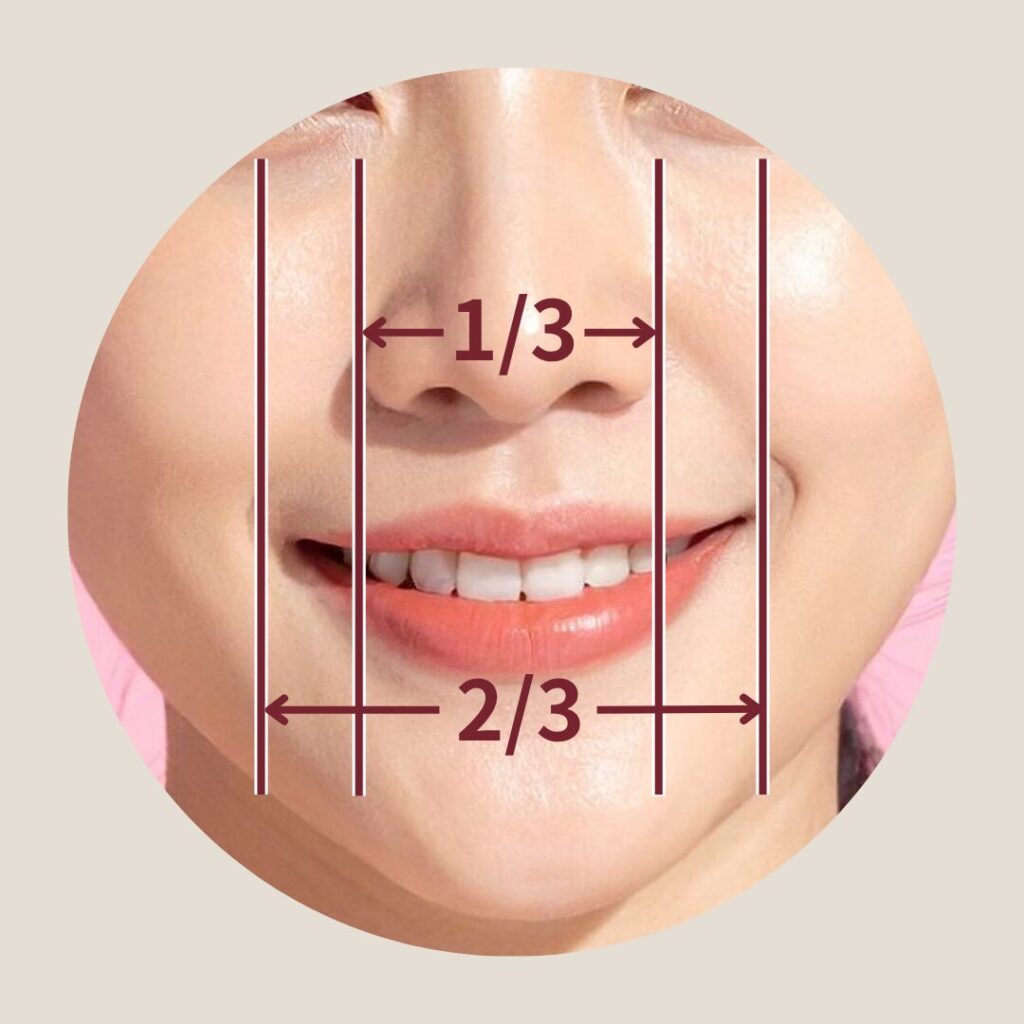
The key point for an ideal nose shape is the balance between the nostrils and other features.
Incidentally, the width ratio of the nostrils to the tip of the nose when viewed from the front is said to be 2:1, considered the golden ratio.
The nose is a central feature of the face, so the balance between the size of the nostrils and the tip of the nose greatly influences one’s overall appearance.
A face where the ratio of the width of the nose—specifically the width of the nostrils—to the width of the lips is “2:3” is also considered well-balanced.
It’s not simply a matter of having small nostrils being better; whether the nose is wide or narrow, if the balance is off, it tends to create an unnatural appearance.
Conversely, even women with large nostrils can appear beautiful if their features are well-balanced.
This doesn’t apply to everyone, but since the shape and placement of the nose and other features can change a face’s impression, please consider this merely as a guideline.
How do the sizes of your nostrils compare to the average? How to check for balance

If you’re concerned about the difference between the size of your nostrils and the average, first check how they balance with your other facial features.
Is the width of the nostrils the same as the distance between the inner corners of the eyes?
The ideal width for a well-balanced nose is roughly equal to the distance between the inner corners of the eyes.
When the width of the nostrils and the distance between the inner corners of the eyes are roughly equal, the overall impression of the nose becomes less prominent, creating a more refined appearance.
Incidentally, for Japanese people, even if the width of the nostrils is slightly larger than the distance between the inner corners of the eyes, it doesn’t really throw off the balance.
For example, if the distance between the inner corners of the eyes is 3.5 cm, the ideal width of the nostrils is approximately 3.5 to 3.7 cm.
Check the relative positions of the “nasal bridge” and “nostrils”
Whether your nostrils appear large depends not only on the width of the alar base but also on their position relative to the columella. The “columella” refers to the cartilage section located between the nostrils.
When viewed from the front, a balanced placement is said to occur when the columella sits slightly below the extension lines of the lower edges of the nostrils on both sides.
The ideal shape is a downward-pointing isosceles triangle formed by connecting the tip of the nose bridge to the points below both nostrils.
When the nasal bridge is positioned higher than the line connecting the nostrils, it may give the impression of a large, rounded nose tip.
Additionally, even when the nasal septum is positioned below the line connecting the nostrils, if it protrudes significantly, the nostrils may become more noticeable when viewed from the side.
What are the main reasons why nostrils appear large?
The following are reasons why nostrils may appear large.
- The shape of the nose determined by genetics
- Age-related bone density loss and skin sagging
- The habit of frequently touching one's nose
- The influence of daily habits, etc.
Noses with features such as large or wide-spreading nostrils tend to have prominent nasal cavities.
Additionally, as bone density decreases with age, the nasal cavity within the skull may expand. This can occur as the cartilage and skin stretch laterally, potentially widening the nasal passages.
In addition to actions like sticking fingers in the nostrils, habits such as facial expressions, teeth grinding, and clenching can make the nostrils appear larger.
【Q&A】Frequently Asked Questions About Nostril Size

Next, we’ll address some common questions about the size of nostrils.
Q. Why do my nostrils look bigger when I laugh?
The reason your nostrils appear larger when you smile is because the muscles in your cheeks and jaw pull on them as you form a smile. Due
to facial structure, everyone’s nostrils spread when they smile. However, depending on muscle strength, habitual expressions, and natural shape, the nostrils may appear more emphasized.
Q. Why is there a difference in the size of my nostrils on the left and right sides?
If you notice a difference in the size of your nostrils, the main causes are typically the following three:
- The shape of the nasal cartilage at birth
- Past injuries
- Habits such as chewing on one side or resting one's chin on one's hand
The shape or curvature of the nasal septal cartilage, which divides the nostrils, can sometimes cause the nostrils to appear asymmetrical in size.
In this case, it is likely that genetic factors are at play.
Additionally, injuries such as a broken nose or contusion can cause deformation of the nasal septal cartilage or bone, leading to asymmetry in the nostrils.
Additionally, habits such as chewing on one side, habitual facial expressions, or resting your chin on your hand can cause pressure to be applied to one side of the face. This pressure may affect the cartilage and bone structure, potentially leading to asymmetry in the size of the nostrils.
Q. Does picking your nose make your nostrils bigger?
It’s hard to imagine that poking around inside your nose with your finger could dramatically enlarge the nostrils.
The skin on the sides of the nose is thick and tough, making it less elastic compared to skin on areas like the abdomen.
Therefore, unless considerable force is continuously applied from inside the nose over a long period, the size of the hole is unlikely to significantly increase.
That said, it’s best to avoid actions like leaving devices designed to reshape the nostrils inserted for extended periods, as this could potentially lead to deformation of the nostrils.
Solve your nostril concerns at the root! Aesthetic medical options
If you want to fundamentally resolve concerns about the size of your nostrils, consider cosmetic surgery as an option.
Some people may be researching the effectiveness of self-administered massage or nose clips as methods to make their nostrils smaller.
However, self-care alone has its limits when it comes to maintaining your ideal appearance.
Here, we explain cosmetic medical treatments designed to fundamentally reduce the size of the nostrils.
Nostril Reduction|Reduce the width of the nostrils to make the nasal openings smaller
Nasal alar reduction is a procedure that reduces the width and size of the nose by removing skin from the inner or outer sides of the nostrils, creating a more subtle appearance.
It is also sometimes called “nose wing reduction.”
Among alar base reduction techniques, the internal approach involves excising tissue from the inner part of the nostrils, known as the nasal floor, to narrow the width and reduce the size of the nostrils. The external approach reduces the volume of the alar base.
This is ideal for those who feel their nostrils are larger than average or are concerned about their nostrils flaring out when they smile.
▷Nasal Wing Reduction
Nasal Alar Base Reduction|Shaping the Appearance of the Nostrils from the Front
“Nasal alar rim lowering” is a procedure that involves transplanting cartilage and skin from the ear to the underside of the edge of the nostrils.
If the curve of the nostrils is distinctly upturned, their size may be noticeable.
By performing a nasal alar rim reduction, the sharply angled curve is softened, making the nostrils less noticeable.
This procedure not only reduces the size of the nostrils but also improves their balance when viewed from the front and, of course, from the side.
If you wish to make your nostrils appear smaller than average, nostril rim reduction surgery can reshape them to make their size less noticeable.
▷Nasal alar margin descent
At LIVIN CLINIC, we perform natural-looking alar base reduction surgery with no discomfort, utilizing our proprietary techniques and thorough postoperative management.
The size of your nostrils matters more than the average size—balance is key! Start with a consultation.
If you’re concerned about the size of your nostrils, instead of comparing them to the average, check how they measure up to the rest of your features.
When aiming for an ideal facial appearance, overall balance is more important than the size of the nostrils. It is also essential to analyze why your nostrils appear large.
First, start by getting counseling at the clinic to find the right balance for you.
Nasal Wing Lowering Procedure Details, Risks, and Side Effects
【Procedure Details】Nasal Alar
Base Reduction 【Estimated
Duration
and Number of Sessions】Typically 1 session ※May vary depending on individual condition.
【Procedure Time】Approximately
1
hour
【Cost】¥385,000 to ¥495,000 ※This procedure is self-pay (not covered by insurance).
【Face Washing and
Bathing】No nasal splint is required. Face washing is possible starting
the next day. For alar base reduction, a nasal splint must be worn for one week post-surgery.
【Makeup】 Sutures are
removed one week after surgery, and makeup may be applied starting the day after removal. 【Risks and Side
Effects (Possible
Occurrences)】 Infection, wound dehiscence, impaired blood flow, swelling, bruising, nosebleeds, nasal congestion, scarring on the columella, decreased sensation in the nasal tip or ear lobes, nasal tilt, inability to elevate the nasal tip, asymmetry in nasal shape, hardening of the nasal tip, sensation of a rounded nasal tip.
Nostril Reduction (Alar Reduction): Procedure Details, Risks, and Side Effects
【Procedure Details】Nostril
Reduction (Nasal Wing Reduction
) 【Estimated Treatment Duration and
Sessions】Typically 1 session ※May
vary depending on individual condition.
【Procedure
Time】Approximately
1 hour 【Cost】¥330,000~¥495,000 ※This procedure is self-pay (not covered by insurance).
【Face Washing,
Bathing】No nasal splint is required. Face washing is possible starting the next day.
【Makeup】 Sutures are removed after one week
. Makeup may be applied starting the day after suture removal. 【Risks & Side Effects
(Possible Occurrences)】
Infection, wound dehiscence, impaired blood flow, swelling, bruising, nosebleeds, nasal congestion, columellar scarring, decreased sensation in the nasal tip or ears, nasal tilt, inability to elevate the nasal tip, asymmetry in nasal shape, hardening of the nasal tip, sensation of a rounded nasal tip.
▼Recommended articles for you after reading this piece
Nostril Reduction: Solve Your Nose Concerns. Detailed Explanation from Procedure Types to Downtime
For those who want a straighter nose bridge. The Complete Guide to Achieving Your Ideal Profile

Supervisor of this article
Director Yoshiaki Shingyochi
Director of LIVIN CLINIC and a specialist in plastic and cosmetic surgery. After graduating from Juntendo University School of Medicine, he gained extensive experience as a department head and vice director before assuming his current position in 2025. He specializes in nose and eye area procedures, breast augmentation, and other surgeries, earning the trust of patients both domestically and internationally. Guided by the belief of “maximizing each patient's unique beauty,” he provides high-quality treatment through advanced techniques and meticulous procedures. Director of LIVIN CLINIC, Board-Certified Plastic Surgeon, Board-Certified Aesthetic Surgeon (JSAPS), Doctor of Medical Science, Adjunct Assistant Professor, Department of Plastic Surgery, Juntendo University.
Share this article
-

Share on X
-

Share on Facebook
-

Share on LINE
-
リンクをコピーしました