
Why Does Alar Reduction Make Your Smile Look Unnatural? Explaining How to Avoid Regret

You may have seen information on social media suggesting that alar reduction surgery can make your smile look unnatural. While it’s true that there is a period after alar reduction surgery when facial expressions may feel restricted, this is usually temporary. However, in rare cases, symptoms can persist longer. This article explains in detail the reasons why alar reduction might make your smile appear unnatural and what to do if symptoms linger. If you’re considering alar reduction surgery, please use this information as a reference.
Reasons why people feel their smile looks unnatural after alar reduction surgery

Alar reduction is a procedure that removes part of the skin on the sides of the nose to reduce its volume and create a more refined appearance. It addresses concerns such as “my nose spreads when I smile” or “I’m self-conscious about the size of my nostrils.” This treatment aims to minimize the appearance of flared nostrils and make the nostrils less noticeable, helping to improve the overall balance of the face.
However, in alar reduction surgery, symptoms such as “difficulty moving facial expressions” or “tightness in the nose when smiling” may occur postoperatively. The primary causes are as follows:
● Temporary swelling and pain
during downtime ●
Tightness due to skin and tissue repair ● Excessive excision due to surgical technique selection or design errors
After alar reduction surgery, swelling and puffiness occur, and the nasal tissue temporarily becomes firm. You may find it difficult to smile due to pain. Furthermore, as the injured skin and tissue heal, they change by becoming firm and tight, making it harder to move facial expressions.
Additionally, excessive removal due to poor surgical technique selection or design errors is another cause of unnatural-looking smiles. For alar reduction, multiple techniques exist—such as the internal approach, which reshapes the inside of the nose, or the external approach, which reduces external volume. However, if the chosen technique doesn’t suit the nose’s shape, it can create an unnatural appearance. Furthermore, if the design results in poor overall facial balance, it may cause a feeling of tightness when smiling.
How long will this feeling of discomfort in my smile last? The post-operative recovery process
Discomfort such as “an unnatural smile” or “a tight feeling in the nose” after alar reduction surgery will gradually subside over about three months. Monitor the progress of your recovery period from immediately after surgery until around three months.
Immediately after surgery to 1 week
For the first 2 to 3 days after alar reduction surgery, swelling and bruising tend to be most noticeable. When you smile, the skin and muscles around the nostrils move, causing a tingling pain that makes it difficult to form facial expressions. If you feel pain, avoid forcing a smile. Take the prescribed pain medication and rest. After the sutures are removed one week post-surgery, the wound condition stabilizes and the swelling gradually subsides.
1 week to 1 month after surgery
About 1 to 2 weeks after surgery is when bruising and redness typically subside. Pain when smiling and tightness around the nostrils will ease, gradually making facial expressions easier to move. Around one month post-surgery, significant swelling and firmness will become less noticeable, making it easier to smile.
1 to 3 months after surgery
Around 1 to 3 months after surgery is when any discomfort from the procedure typically subsides. By this time, you should find it easier to move your facial expressions naturally. Some people may notice redness around the incision site, but this can be concealed with makeup.
Achieve a Natural Smile with Alar Reduction! Key Points for Choosing a Clinic You Won’t Regret

Many people may feel anxious about the procedure after seeing blogs or photos of failed alar reduction surgeries, worrying, “Will I end up with a face that can’t smile?” Choosing the right clinic is crucial to avoid regret. To ensure you feel glad you had alar reduction, make sure to understand the key points for selecting a clinic.
Do you possess the ability to propose and execute technical procedures?
To avoid regretting alar reduction surgery, you need a doctor with strong proposal skills and technical expertise. Simply making a wide nose smaller won’t achieve your ideal result, even if a wide nose is your complex. The doctor must propose and execute the appropriate surgical technique and design, considering your bone structure and facial balance. If you find a clinic you like, check their technical skills and track record by reviewing the case photos posted on their website.
Will they carefully listen to your anxieties and aspirations during counseling?
How the clinic handles consultations is also a key factor in choosing a clinic. During the consultation, it’s important to communicate any anxieties or questions you have about the procedure and to feel satisfied with the explanation of the effects and risks of alar reduction. A doctor who carefully listens to your concerns and ideal outcomes, and thoroughly explains the risks and the importance of downtime, can be considered highly trustworthy.
Is the post-operative follow-up system well-established?
Post-operative aftercare is another key point to check when considering alar reduction surgery. After the procedure, symptoms such as swelling, pain, and bruising may occur. While these symptoms typically subside gradually, they can occasionally worsen. In some cases, revision surgery may be necessary. Having a clinic’s consultation service or warranty system in place ensures prompt assistance if any issues arise post-surgery. To prepare for any unforeseen circumstances, choose a clinic with a robust aftercare system.
What if postoperative discomfort persists? Possible solutions
If you experience persistent discomfort such as an unnatural smile or severe swelling after alar reduction surgery, take the following steps:
- Consult the clinic where you received treatment
- Perform appropriate self-care under the guidance of a physician.
- In some cases, revision surgery may be considered.
If swelling, pain, or other downtime symptoms persist after alar reduction surgery, consult the clinic where you received the procedure first. A clinic with a well-established aftercare system should examine your symptoms and provide appropriate instructions for managing them. If your condition can be managed with self-care, follow your doctor’s instructions by taking prescribed medication and maintaining cleanliness while focusing on recovery.
If recovery is not expected through self-care, revision surgery is one option. However, it is more difficult than the initial procedure and may not result in an aesthetically pleasing outcome. Additionally, if an infection is present, revision surgery may not be possible due to the risk of reinfection. Therefore, it is crucial to discuss revision surgery thoroughly with your doctor before deciding.
LIVIN CLINIC’s Commitment to “Natural Nose Wing Reduction That Blends Seamlessly with Your Facial Features”
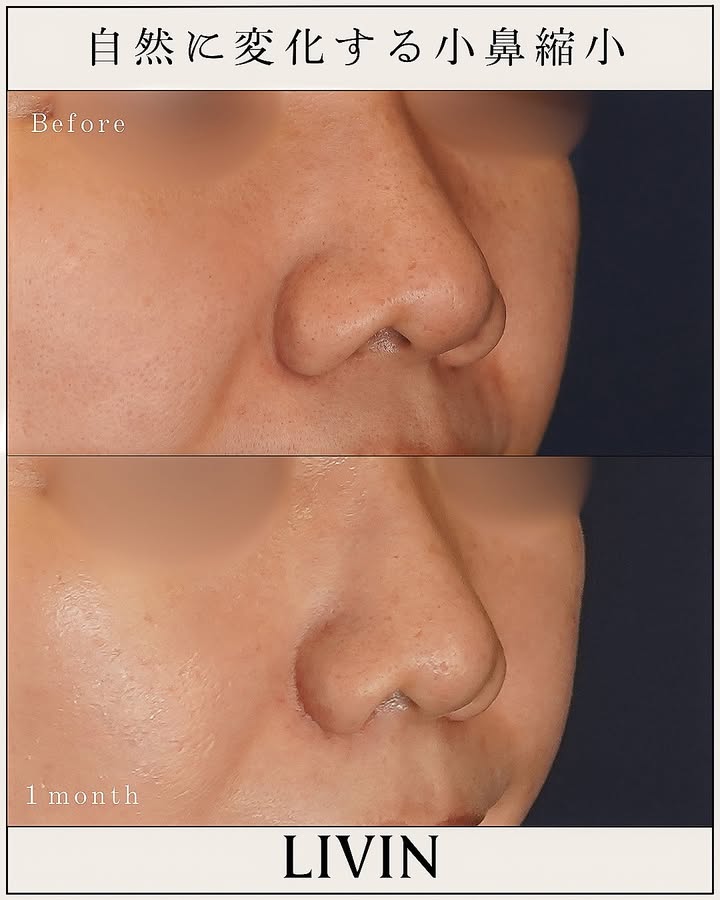
【施術内容】鼻翼縮小(小鼻縮小)
【画像の説明】上:施術前 下:施術1ヶ月後
【費用】330,000~495,000円
【副作用・リスク】感染、傷痕、創離開、左右差、後戻りなど
LIVIN CLINIC’s alar base reduction (nose wing reduction) prioritizes achieving noticeable changes while maintaining a natural finish. The clinic’s main features are as follows:
Custom-made designs tailored to your concerns
At LIVIN CLINIC, we conduct thorough consultations and simulations before any procedure. We listen closely to each individual’s concerns, value their unique qualities, and design the final look while considering the overall facial balance. We propose plans that bring out your true self. During the simulation, we take photos and adjust them in Photoshop to confirm the final result. This allows you to easily visualize the three-dimensional outcome.
▷Nostril Reduction (Alar Reduction)
Procedures performed by physicians with extensive knowledge in the field of plastic surgery
LIVIN CLINIC’s alar base reduction (nose wing reduction) is performed by physicians with extensive knowledge in plastic surgery and experience in aesthetic medicine. Specializing in facial surgical treatments including rhinoplasty, they are chosen by many for their proven technical skill and aesthetic sensibility.
Comprehensive support for peace of mind after surgery
At LIVIN CLINIC, we carefully explain aftercare tailored to each procedure, including how to spend your downtime and self-care methods. After alar reduction (nose wing reduction), improper care can worsen swelling and pain, requiring caution. We support you with the correct care to ensure a smooth post-operative period.
If you’re concerned about the width of your nose or worried about others noticing your alar reduction, please consult LIVIN CLINIC.
▼Book your nasal wing reduction (nose tip reduction) appointment here
Frequently Asked Questions About Postoperative Care for Alar Reduction Surgery
Now, let’s look at some common questions about the postoperative period for alar reduction surgery.
Q. Is there a chance the string might snap if I laugh really hard?
After alar reduction surgery, laughing too hard may cause the sutures used for fixation to break. Until the sutures are removed, be careful not to laugh excessively. The likelihood of suture breakage varies depending on the surgical technique and extent of excision, so it is important to carefully review the post-operative precautions.
Q. Does Botox for alar reduction affect your smile?
Even with Botox injections for alar reduction, incorrect injection sites or excessive amounts can result in an unnatural smile. To avoid regret with alar reduction, be sure to consult a physician with solid technical skills.
Q. How long does it take for scars to become less noticeable?
Scarring from alar reduction varies from person to person, but generally becomes less noticeable within 1 to 3 months. The scar is more visible until the stitches are removed, but after removal, it will gradually heal and become coverable with makeup.
Achieve Your Ideal Nose with Proper Care After Alar Reduction Surgery
After alar reduction surgery, you may feel your smile looks unnatural. However, by carefully following post-operative care instructions, you’ll be able to smile naturally again within about 1 to 3 months. Choosing the right clinic is crucial for achieving your ideal facial appearance through alar reduction. Check the quality of consultations and follow-up care, as well as the surgeon’s experience and technical skill, to find a trustworthy clinic where you can achieve your desired look.
▼Recommended articles for you after reading this piece
Nostril Reduction: Solve Your Nose Concerns. Detailed Explanation from Procedure Types to Downtime
For those who want a straighter nose bridge. The Complete Guide to Achieving Your Ideal Profile
【Procedure Details】Nostril
Reduction (Nasal Wing Reduction) 【Estimated Duration
and Number of
Sessions】Typically 1 session ※May
vary depending on individual condition.
【Procedure Time】Approximately
1 hour 【Cost】¥330,000~ ※This procedure is self-pay (not covered by insurance).
【Face Washing, Bathing】No nasal
cast is applied. Face washing is possible starting the next day.
【Makeup】 Sutures are removed after one week
. Makeup may be applied starting the day after suture removal.
【Risks & Side Effects (Possible Occurrences)
】Infection, wound dehiscence, impaired blood flow, swelling, bruising, nosebleeds, nasal congestion, scarring on the columella, decreased sensation in the nasal tip or ears, nasal tilt, inability to elevate the nasal tip, asymmetry in nasal shape, hardening of the nasal tip, sensation of a rounded nasal tip.

Supervisor of this article
Director Yoshiaki Shingyochi
SHINGYOCHI Yoshiaki
Director of LIVIN CLINIC and a specialist in plastic and cosmetic surgery. After graduating from Juntendo University School of Medicine, he gained extensive experience as a department head and vice director before assuming his current position in 2025. He specializes in nose and eye area procedures, breast augmentation, and other surgeries, earning the trust of patients both domestically and internationally. Guided by the belief of “maximizing each patient's unique beauty,” he provides high-quality treatment through advanced techniques and meticulous procedures. Director of LIVIN CLINIC, Board-Certified Plastic Surgeon, Board-Certified Aesthetic Surgeon (JSAPS), Doctor of Medical Science, Adjunct Assistant Professor, Department of Plastic Surgery, Juntendo University.
Share this article
-

Share on X
-

Share on Facebook
-

Share on LINE
-
リンクをコピーしました