
What Are the Characteristics of a Rhinoplasty Nose? Explaining Why It Can Be Detected and Key Points for a Natural Finish
Many people don’t want their nose to look like it’s been surgically altered. That’s why we’re explaining the characteristics of a surgically altered nose that are easily noticeable to others. We’ve summarized the reasons why surgery becomes obvious and the key points for achieving a balanced result. We’ll also introduce nose surgery methods that yield natural-looking results tailored to specific concerns. If you’re thinking, “I don’t want others to notice,” or “I want to avoid a face that screams ‘surgery,'” please consider this information.
What are the characteristics of people who have had rhinoplasty?
Many people want to get nose surgery but don’t want others to notice. So first, here are five characteristics of unnatural-looking surgically altered noses.
The bridge of the nose is unnaturally high from the brow ridge.
Making the bridge of the nose too high can easily look unnatural. Japanese faces typically lack deep facial contours. Therefore, a nose that is raised from the bridge area may not suit the face.
The outline of the prosthesis appears to protrude
Cases where the outline of a prosthesis inserted to make the nose appear higher is visible through the skin are also likely to look unnatural. A prominent example is when a step or step-like contour forms along the bridge of the nose. Furthermore, if the prosthesis is placed too shallowly, it may appear whitish through the skin.
The size of the nostrils is too small in relation to the face.
One procedure for nose reshaping is “nose wing reduction” (also known as alar reduction), which narrows the width of the nose. However, excessively narrowing the width during this procedure can disrupt the overall balance and result in an unnatural appearance.
The tip of the nose is artificially pointed.
The characteristics of a surgically altered nose can also be seen in the tip. If the tip is made pointed through procedures like cartilage grafting, the surgery may become obvious.
Limited nasal movement during facial expressions
After rhinoplasty, facial expressions may appear stiff or look pulled tight when smiling. While most cases are temporary, be aware that excessive surgery or improper procedures carry the risk of prolonged effects.
【Rhinoplasty】Three Reasons for an Unnatural Result
Here are three reasons why the characteristics of a surgically altered nose become noticeable.
Design that does not consider the overall balance of the face
The key to achieving a natural-looking rhinoplasty result lies in designing the nose with consideration for the overall facial balance. When considering the design, many patients pursue their ideal, such as “I want a straight nasal bridge” or “I want to minimize the width of my nostrils as much as possible because I’m self-conscious about them.” However, deciding on a design without considering the overall facial balance may result in the nose appearing out of place.
The incision site or surgical technique is inappropriate.
While rhinoplasty is often grouped together, the surgical techniques vary widely. Multiple approaches exist, including implant insertion and partial tissue removal. Furthermore, even with the same technique, the final result changes depending on the incision location. If the approach doesn’t suit your specific concerns, achieving your ideal nose will be difficult.
Physicians lack technical skills and experience.
The nose is an area where the surgeon’s skill and experience can significantly impact the final result. Even a difference of just 1mm in the treatment area can greatly affect the outcome. In fact, unnatural balance or shape—hallmarks of botched nose jobs—are often caused by the surgeon’s lack of skill.
Key points for achieving a natural-looking nose that goes unnoticed by others
So, how can you avoid ending up with an unnatural-looking nose after surgery? Here are some key points to ensure others won’t notice you’ve had work done.
Pursuing the design that best suits one’s facial features
Strive for a design that harmonizes with your entire face. The key is to choose a design that suits your bone structure and facial features, rather than fixating solely on an ideal nose shape and making it excessively tall. For example, if you have deep-set facial features like those of Westerners, a taller nose will likely match your face better.
Understanding the advantages and disadvantages of each treatment method
To achieve a natural-looking result with rhinoplasty, selecting the appropriate surgical technique is essential. When choosing a technique, it’s important to understand both the expected outcomes and the associated risks. For example, even procedures aimed at the same goal of “raising the nose” can involve different methods, such as inserting a prosthesis or using ear cartilage grafting, each with its own advantages and disadvantages. Understanding these pros and cons will help you select the most suitable surgical approach.
Choose a doctor with extensive experience and a proven track record
Choosing the right surgeon is crucial for successful rhinoplasty. Check reviews and before-and-after photos to select a clinic with cases that closely match your desired outcome. Consider the surgeon’s specialty, qualifications, and experience when evaluating their skill. Additionally, a surgeon who provides thorough consultations is likely to be more trustworthy.
Types of Rhinoplasty for a Natural, Beautiful Finish Based on Your Concerns
Here, we’ll introduce methods for rhinoplasty that aim for a natural finish. Let’s look at three types of procedures that minimize the unnatural appearance often associated with surgically altered noses, categorized by concern.
If you want to refine your nose tip and eliminate a bulbous nose, consider “rhinoplasty.”
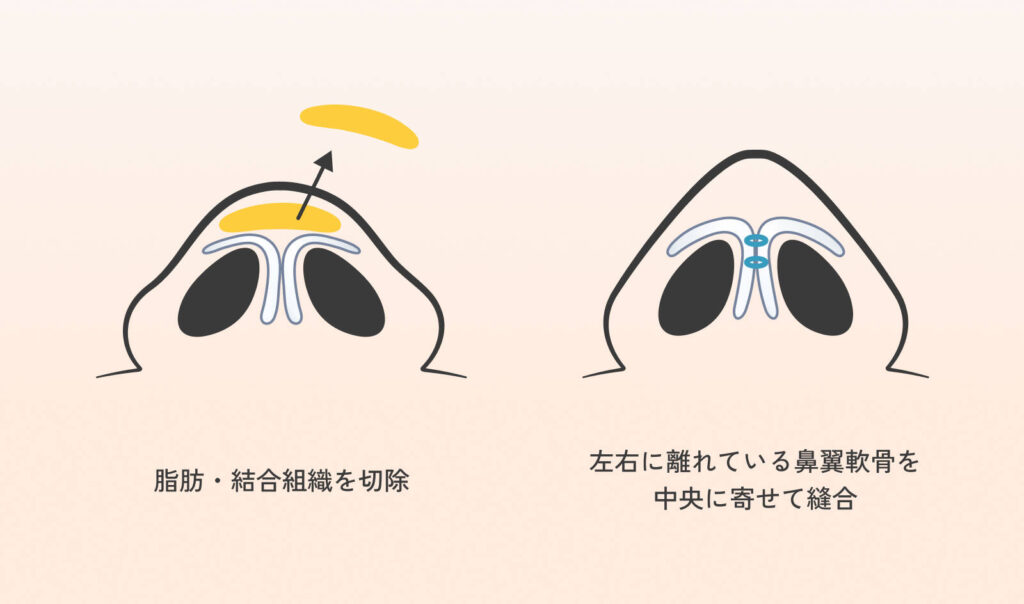
Nose tip reshaping is a procedure that refines the tip of the nose. Common techniques involve suturing the alar cartilage that forms the tip or transplanting ear cartilage to the nasal tip to create a sharper appearance. Nose tip reshaping is suitable for individuals with the following characteristics:
・Want to eliminate a bulbous nose
・Want to raise
the tip of the nose ・Want to correct the direction of the nose tip to improve a pig nose or witch nose
Nasal tip reduction is a relatively straightforward procedure that leaves minimal visible scarring. However, there is a risk of relapse if the sutures securing the alar cartilage become loose or dislodge. LIVIN CLINIC employs the “Cormer-Lestrat technique” for nasal tip reduction, which minimizes the risk of relapse. This method reinforces the nasal bridge with grafted cartilage, achieving a stable result while effectively enhancing nasal height.
▷Treatment Details Here
If you want to improve a short or upturned nose, consider “nasal septum extension.”
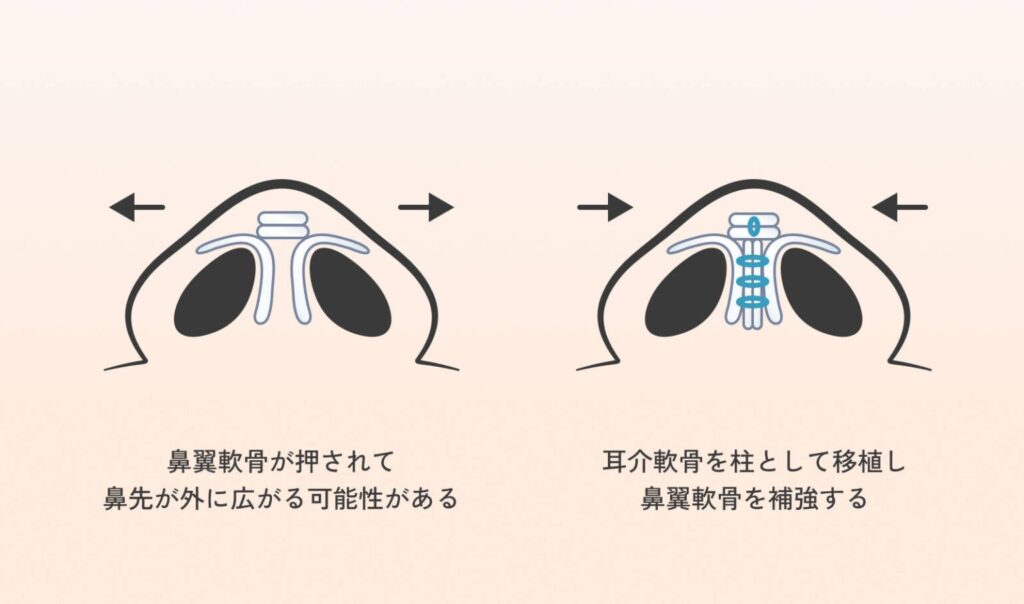
Septal extension is a procedure that enhances the height and angle of the nasal tip by reinforcing the nasal septal cartilage located in the center of the nose. It primarily involves transplanting auricular cartilage or costal cartilage to the septal cartilage area to reshape it. Individuals suitable for septal extension typically exhibit the following characteristics:
・Want to change the direction of the nasal tip to eliminate a pig nose or witch nose ・Want to raise
the nasal tip ・Want to add dimension to the
midface
When using auricular cartilage for septal extension, it is said to be softer than costal cartilage and less effective at achieving significant changes. At Livin Clinic, however, we employ a specialized method to securely anchor the auricular cartilage to the nasal septum. This allows us to achieve strength and visible changes comparable to those obtained with costal cartilage. Furthermore, a key feature of Livin Clinic’s septal extension is the ability to achieve substantial changes while maintaining a natural finish that harmonizes with the overall facial balance.
▷Treatment Details Here
For a perfectly straight, ideal nose bridge, consider a “nose implant.”
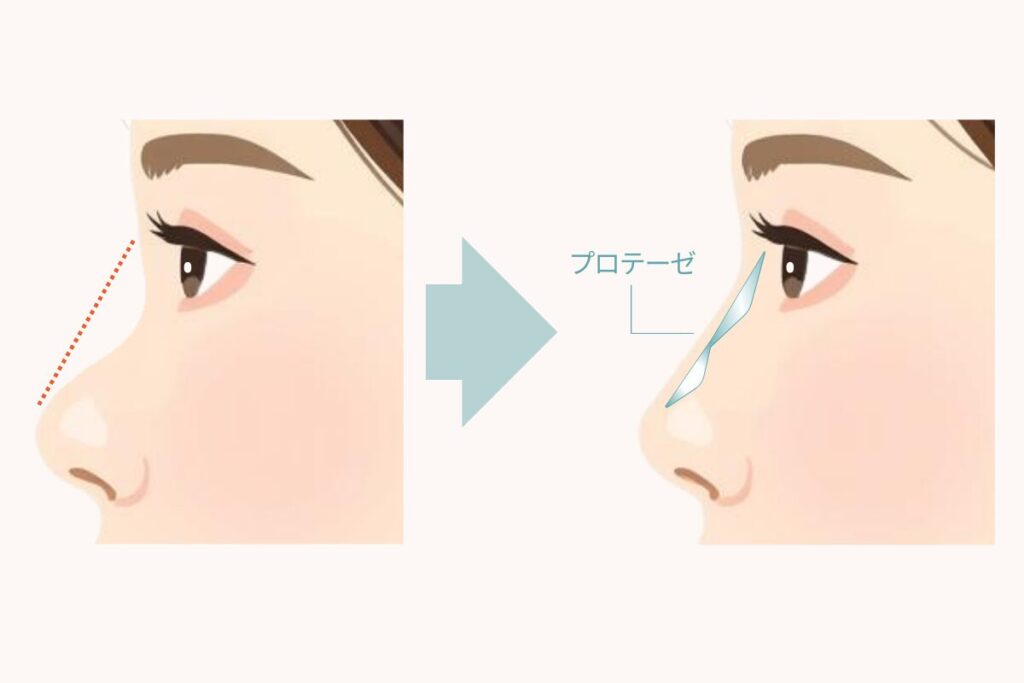
A nasal implant procedure involves inserting a silicone prosthesis. It elevates the bridge of the nose, creating a more defined facial profile. Below are characteristics of individuals for whom a nasal implant is recommended.
・Want a more defined nasal bridge ・Want
to raise the bridge from the root of the nose
Immediately after insertion, the position of the nasal implant is not yet stable. Therefore, immobilization with a cast is essential for approximately 5 to 7 days post-surgery. Please understand that washing your face or hair is not possible during this immobilization period.
Additionally, if you have naturally close-set eyes and undergo nasal implant insertion, your eyes may appear even closer together. Consequently, a procedure that considers the overall facial balance is essential. At RIVIN Clinic, our experienced surgeons will propose a procedure that achieves balanced results.Furthermore, CT scans can be performed to create a custom-made prosthesis.
▷Treatment Details Here
Frequently Asked Questions About Rhinoplasty
Finally, we’ll address some common questions about rhinoplasty. If you’re considering rhinoplasty, please use this as a reference.
Q. Will there be any scars after the procedure?
A. Scars from rhinoplasty gradually fade over time. While results vary depending on the surgical technique and individual factors, in most cases they become less noticeable within about one to two weeks.
Q. How much downtime is required?
A. Generally, the downtime for rhinoplasty is said to be about one week to one month. However, keep in mind that this can vary depending on the surgical method, the size of the incision, and individual differences.
Q. What should I do if I ever want to start over?
A. Revision rhinoplasty is generally possible. However, correcting a nose job requires even more advanced techniques than the initial procedure. Some clinics do not perform revision work, so be sure to confirm beforehand.
Aim for a beautifully balanced nose through appropriate procedures
We’ve introduced facial features resulting from rhinoplasty. Those with nasal insecurities may consider surgery to “make it taller” or “narrow the width.” However, procedures that don’t suit your facial structure or bone framework can accentuate an unnatural “operated look.” To avoid results that fit the profile of an artificial nose, entrust your procedure to an experienced, skilled surgeon.
At Livin Clinic, we have extensive experience with rhinoplasty cases. We offer personalized treatment plans and designs tailored to each individual from our range of procedures. Please feel free to consult with us. At Livin Clinic, let’s aim for a beautiful nose that brings out your natural charm.
▼Recommended
Articles for You After Reading This How to Refine Your Nose Bridge | Self-Care and Aesthetic Medicine Guide for Creating Your Ideal Profile [Doctor-Supervised] Effective
Solutions for Fixing a Dumpling Nose |
Explaining Self-Care and Recommended Aesthetic Treatments Eliminate Your Nose Concerns with Alar Reduction. Detailed Explanation from Procedure Types to Downtime
【Procedure Details】Nasal Wing
Reduction (Alar Reduction)
【Estimated Treatment
Duration and Sessions】Typically 1 session ※May
vary depending on individual condition.
【Procedure
Time】Approximately
1 hour【Cost】¥330,000 to ¥495,000 ※This procedure is self-pay (not covered by insurance).
【Face Washing, Bathing】No nasal
cast is applied. Face washing is possible starting the next day.
【Makeup】 Sutures are removed after one week
. Makeup may be applied starting the day after suture removal. 【Risks & Side Effects
(Possible Occurrences)】
Infection, wound dehiscence, impaired blood flow, swelling, bruising, nosebleeds, nasal congestion, columellar scarring, decreased sensation in the nasal tip or ears, nasal tilt, inability to elevate the nasal tip, asymmetry in nasal shape, hardening of the nasal tip, sensation of a rounded nasal tip.
【Procedure】Nasal
Tip
Reshaping
【Estimated Duration and Sessions】Typically 1 session ※May vary
depending on individual condition.
【Procedure Time】Approximately
2-3 hours
【Cost】¥385,000 ※This procedure is self-pay (not covered by insurance).
【Face Washing, Bathing】Face washing is not possible for 5-7 days
post-procedure due to nasal plaster fixation. Showering from the neck down is permitted.
【Makeup】Sutures are removed when
the cast is taken off. Makeup can be applied starting the day after suture removal.
【Risks and Side Effects (Possible Occurrences)】Risks and Side
Effects (Possible Occurrences): Infection, wound dehiscence, blood flow impairment, swelling, bruising, nosebleeds, nasal congestion, columellar scarring, decreased sensation in the nasal tip or earlobes, nasal tilt, inability to elevate the nasal tip, asymmetry in nasal shape, hardening of the nasal tip, sensation of a rounded nasal tip.
【Procedure Details】Nasal
Septum Extension 【Estimated
Duration
and Number of Sessions】Typically 1 session ※May
vary depending on individual condition.
【Procedure Time】Approximately
3 to 5 hours
【Cost】¥660,000 to ¥880,000 ※This procedure is self-pay (not covered by insurance).
【Face Washing and Bathing】Face washing is not possible for 5 to 7 days
post-surgery due to nasal plaster fixation. Showering from the neck down is permitted.
【Makeup】Makeup is permitted starting the day after the cast is removed and
sutures are taken out.
【Risks & Side Effects (Possible Occurrences)
】Swelling, bruising, nosebleeds, nasal congestion, columellar scarring, decreased sensation in the nasal tip or ears, nasal tilt, inability to elevate the nasal tip, asymmetry in nasal shape, hardening of the nasal tip, columellar scarring, rounded sensation in the nasal tip, infection, wound dehiscence, circulatory impairment.
【Procedure Details】Nasal
Implant
【Estimated
Duration and Sessions】Typically 1 session ※May vary depending on individual condition.
【Procedure
Time】Approximately
1 hour 【Cost】¥330,000 ※This procedure is self-pay (not covered by insurance). 【Face
Washing and Bathing】Face washing is not possible for 5-7 days
post-procedure due to nasal cast fixation. Showering from the neck down is permitted.
【Makeup】Makeup is permitted starting the day after the cast is removed
and sutures are taken out
.【Risks & Side Effects (Possible
Occurrences)】Infection, wound dehiscence, impaired blood flow, swelling, bruising, nosebleeds, nasal congestion, scarring on the columella, decreased sensation in the nasal tip, nasal tilt, inability to elevate the nasal tip, asymmetry in nasal shape, hardening of the nasal tip, sensation of a rounded nasal tip.

Supervisor of this article
Director Yoshiaki Shingyochi
SHINGYOCHI Yoshiaki
Director of LIVIN CLINIC and a specialist in plastic and cosmetic surgery. After graduating from Juntendo University School of Medicine, he gained extensive experience as a department head and vice director before assuming his current position in 2025. He specializes in nose and eye area procedures, breast augmentation, and other surgeries, earning the trust of patients both domestically and internationally. Guided by the belief of “maximizing each patient's unique beauty,” he provides high-quality treatment through advanced techniques and meticulous procedures. Director of LIVIN CLINIC, Board-Certified Plastic Surgeon, Board-Certified Aesthetic Surgeon (JSAPS), Doctor of Medical Science, Adjunct Assistant Professor, Department of Plastic Surgery, Juntendo University.
Share this article
-

Share on X
-

Share on Facebook
-

Share on LINE
-
リンクをコピーしました